


Why Getting Your Arch Window Measurements Right Matters
Knowing how to measure arch window for replacement correctly is the difference between a window that fits perfectly and one that costs you time, money, and headaches.
Here’s a quick answer to get you started:
How to measure an arch window for replacement:
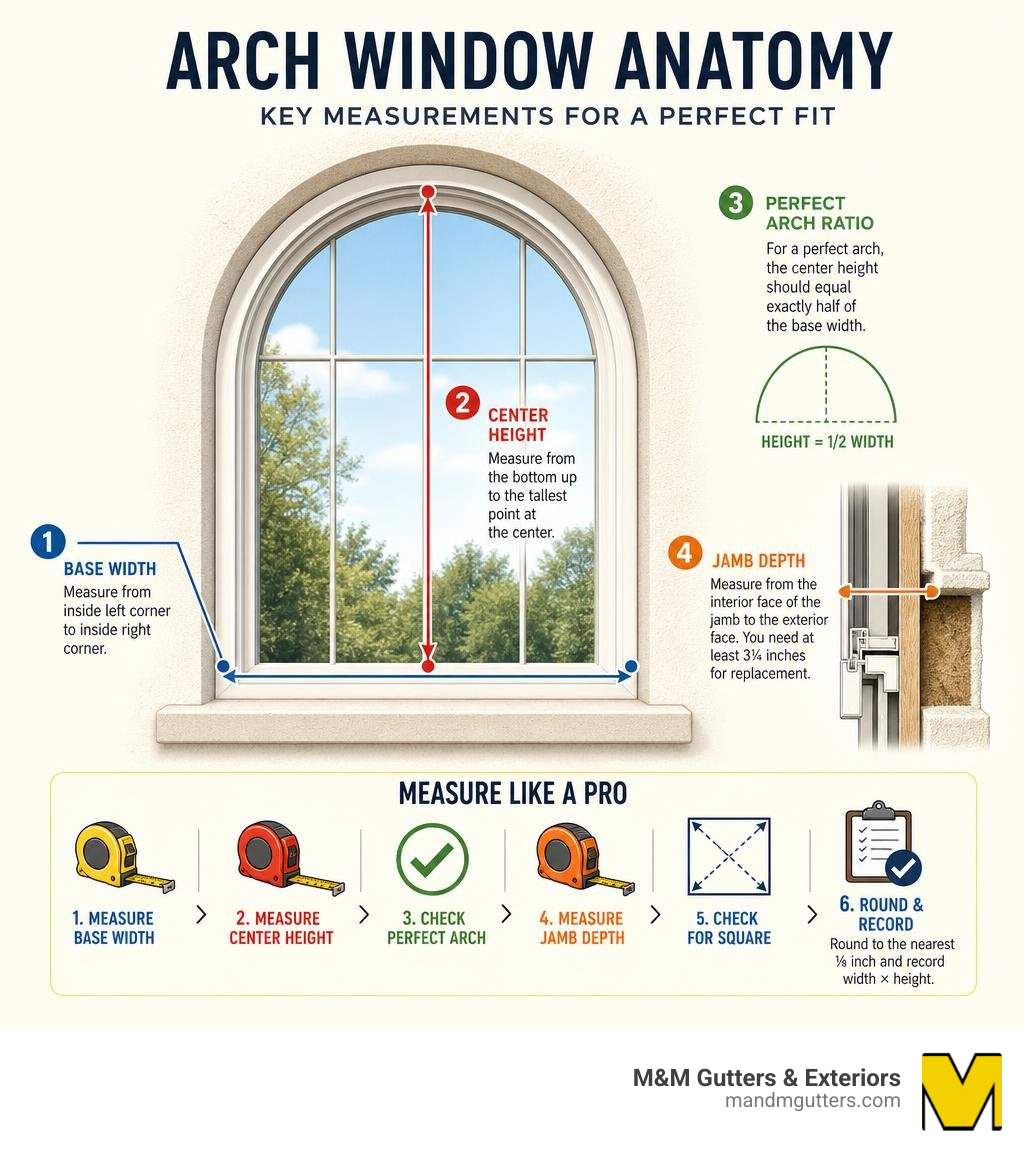
- Measure the base width — from the left to the right corner inside the window opening
- Measure the center height — from the bottom up to the tallest point at the center
- Check for a perfect arch — height should equal exactly half the base width
- Measure the jamb depth — you need at least 3¼ inches for replacement
- Check for square — measure both diagonals; if they differ by more than ½ inch, your frame is out of square
- Round to the nearest ⅛ inch — always record width × height
Arched windows add a classic, timeless look to any home. They bring in natural light and give your exterior real curb appeal. But their curved shape makes measuring trickier than a standard rectangular window — and a wrong measurement means a wrong order.
I’m Nathan Nuttall from M&M Gutters & Exteriors, and after more than 30 years serving Utah homeowners on exterior projects — including window replacements — I know how a precise approach to how to measure arch window for replacement saves costly mistakes before they happen. Let’s walk through everything you need to do it right.
Common how to measure arch window for replacement vocab:
- how do you measure a replacement window
- how to measure for replacement windows in a brick home
- how to measure house windows for replacement
Essential Tools and Safety for Arched Window Measurement
Before we start measuring, let’s get the right tools together. Arched windows are not the place for “close enough,” and cloth measuring tapes belong in the sewing room, not on a replacement window project.
You’ll need:
- Steel tape measure
- Pencil
- Notepad or printed measuring worksheet
- Painter’s tape
- Level
- Straightedge or framing square
- Step ladder, if needed
- Camera or phone for reference photos
- Butcher paper or kraft paper for templates
- Utility knife or scissors for template testing
- Helper, especially for wide or high windows
A steel tape measure matters because it stays straight and gives more consistent readings. A floppy tape can sag across a wide arch and quietly add an expensive mistake to your order.
For specialty windows, it also helps to review general guidance on measuring skylights and arched windows, especially if your project includes a skylight or another hard-to-reach opening.
Now let’s talk safety, because no window is worth a trip to urgent care.
If the window is high on a wall:
- Use a stable ladder on level ground.
- Keep three points of contact on the ladder.
- Do not stand on the top step.
- Have someone hold the ladder.
- Never lean far to one side to “just reach it.”
- Move the ladder instead of stretching.
If measuring requires roof access, we strongly recommend calling a professional. Roof pitch, loose granules, ice, wind, and Utah’s freeze-thaw conditions can turn a simple measurement into a dangerous situation. If roof access is unavoidable, use proper fall protection and never work alone.
Also, take pictures as you measure. A photo showing the tape measure in place can help you or your installer verify the number later. Future-you will be grateful. Future-you may even buy present-you a cookie.
How to Measure Arch Window for Replacement: Step-by-Step

This is the core process for how to measure arch window for replacement. We’ll keep it simple, but do not rush. Measure each window individually, even if two arches look identical. Homes settle, frames shift, and “identical” windows often have tiny differences.
For more general window sizing help, we also recommend our guide: Measuring Up: How to Get Perfect Window Dimensions Every Time.
1. Measure the base width
Measure the inside width at the bottom of the arch opening.
Place your tape at the lower left corner where the arch begins and measure straight across to the lower right corner. This is the base of the arch.
Record it as:
- Base width: ____ inches
For replacement windows, measure the opening itself, not the decorative trim or casing. Trim can hide the real frame dimensions, and ordering from trim-to-trim measurements can create a bad fit.
2. Measure the center height
Find the center point of the base width. The easiest way is to divide the width by two and mark the center lightly with painter’s tape.
From that center point, measure straight up to the tallest point of the arch.
Record it as:
- Center height: ____ inches
This measurement tells you the rise of the arch. On a perfect half-round arch, this number should be exactly half of the base width.
Example:
| Base Width | Perfect Arch Height |
|---|---|
| 48 inches | 24 inches |
| 60 inches | 30 inches |
| 72 inches | 36 inches |
If your 60-inch-wide arch measures 30 inches high, you have a perfect arch. If it measures 26 inches, 34 inches, or anything else, it is not a perfect arch.
3. Measure the total height if the arch sits above a rectangular section
Some arched windows are a true half-circle sitting directly on the sill. Others are elongated arches, with vertical sides below the curve.
If your arch has straight vertical legs, measure:
- Full height from sill to highest point
- Leg height from sill to where the curve begins
- Arch rise from where the curve begins to the highest point
Record all three. We’ll cover elongated arches in more detail below.
4. Measure the jamb depth
Jamb depth is the distance from the interior face of the window opening to the exterior side of the frame area, or from the front of the opening back to the trim or obstruction that limits the replacement unit.
For many replacement windows, you need at least 3 1/4 inches of opening depth. If you do not have enough depth, the project may require a different product, trim modification, or full-frame replacement approach.
Record:
- Jamb depth, left: ____ inches
- Jamb depth, center: ____ inches
- Jamb depth, right: ____ inches
Use the smallest measurement if the depth varies.
5. Measure diagonals to check square
Even though the top is curved, the lower opening and frame still need to be checked for distortion.
Measure from the lower left corner to the upper right transition point, then from the lower right corner to the upper left transition point. If you are measuring a full arched unit with a rectangular section below, measure the diagonals across the rectangular portion.
If the diagonal measurements differ by more than 1/2 inch, the opening is considered significantly out of square. That does not automatically mean replacement is impossible, but it does mean you should not order based on one quick width and height measurement.
6. Record measurements in width x height format
Window measurements are normally written as width x height.
For example:
- 60 inches x 30 inches
- 48 1/8 inches x 24 1/16 inches
- 72 inches x 36 inches
Keep your notes clean and labeled by room. “Big arch upstairs” may make sense today. In two weeks, when you’re comparing three similar windows, it will feel like a riddle from a wizard.
7. Round carefully
Measure to the nearest 1/8 inch unless the manufacturer or installer asks for another precision.
For replacement windows, do not automatically round up. A window that is too large will not fit. In many replacement situations, we measure in multiple places and use the smallest dimension as the controlling number, then let the manufacturer or installer determine proper clearance.
For some window treatments, the rounding rule may be different. For example, certain inside-mounted skylight shades may require rounding up to the nearest 1/8 inch and at least 2 inches of mounting depth. That is why it is important to separate “replacement window measurements” from “shade or blind measurements.”
Perfect Arches vs. Non-Perfect Arches and Specialty Shapes
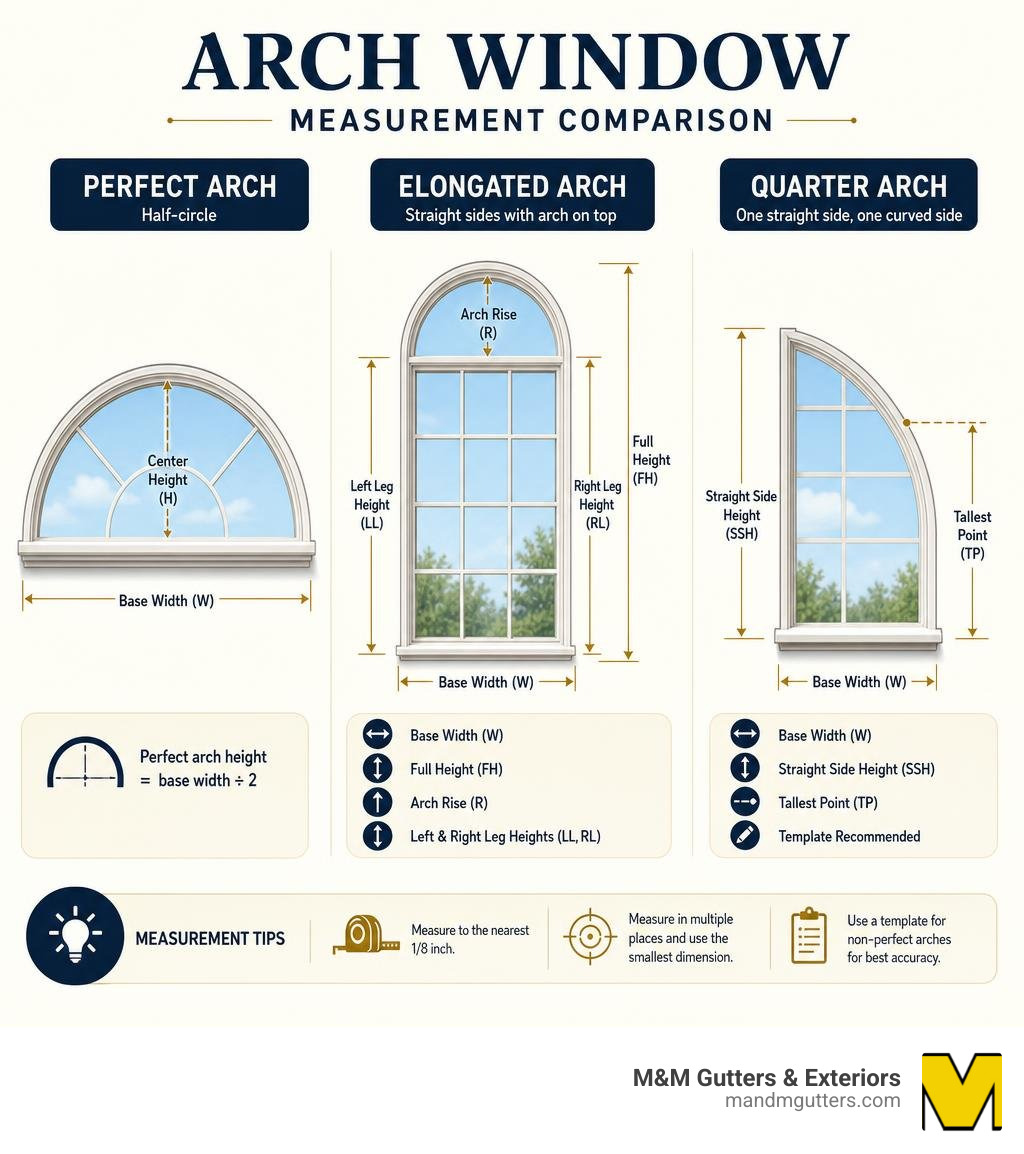
A perfect arch is a half-circle. The height of the arch equals exactly half the base width.
Formula:
Perfect arch height = base width ÷ 2
So if the base width is 64 inches, the perfect arch height is 32 inches.
A non-perfect arch does not follow that ratio. It may be flatter, taller, stretched, eyebrow-shaped, elongated, or asymmetrical. Non-perfect arches are common in custom homes and older homes throughout Salt Lake City, Salt Lake County, Utah County, Summit County, Tooele County, Davis County, Weber County, and Northern Utah.
This is where careful measuring matters. It is also where a paper template can save the day.
For other curved-window measuring concepts, see our related guide on bay and bow replacement measurements.
| Arch Type | What It Looks Like | Measurements Needed | Special Notes |
|---|---|---|---|
| Perfect arch | Half-circle | Base width, center height, jamb depth | Height equals half the width |
| Non-perfect arch | Curve is flatter or taller than half-circle | Base width, center height, multiple curve points, template | Do not assume standard sizing |
| Elongated arch | Straight sides with arch on top | Base width, full height, leg heights, arch rise | Measure both legs separately |
| Quarter arch | One straight side and one curved side | Base width, straight-side height, tallest point, template | Often needs extra verification |
| Eyebrow arch | Low, shallow curve | Width, rise, multiple points along curve | Template is strongly recommended |
How to measure arch window for replacement when dealing with elongated shapes
An elongated arch has vertical sides below the curved top. Think of it like a rectangle wearing a fancy hat.
To measure an elongated arch:
- Measure the base width at the bottom opening.
- Measure the full height from sill to highest point.
- Measure the left leg height from sill to where the curve begins.
- Measure the right leg height from sill to where the curve begins.
- Measure the arch rise from the curve-start line to the highest point.
- Measure jamb depth.
- Check diagonals across the rectangular lower section.
Record:
- Base width: ____ inches
- Full height: ____ inches
- Left leg height: ____ inches
- Right leg height: ____ inches
- Arch rise: ____ inches
- Jamb depth: ____ inches
Do not assume the left and right legs are the same height. If one side is even 1/4 inch different, the arch may not sit correctly without adjustment.
For elongated arches, a template is often helpful because the curve may not be a standard radius.
How to measure arch window for replacement with quarter-circle designs
A quarter arch is usually one-fourth of a circle. It may appear above a door, beside another window, or as part of a larger architectural design.
To measure a quarter arch:
- Measure the base width along the bottom.
- Measure the straight vertical side from bottom to tallest point.
- Measure the curved side height at several points if possible.
- Measure the jamb depth.
- Note which direction the curve faces: left-hand or right-hand.
- Create a paper template if the shape is custom or uneven.
Quarter arches are easy to flip by mistake when ordering. Always label:
- Top
- Bottom
- Room side
- Exterior side
- Left curve or right curve
If the window is part of a pair, label each unit separately. “Left arch” should mean left as viewed from inside the room unless your order form says otherwise.
Inside Mount vs. Outside Mount and Depth Requirements
Inside mount and outside mount language is most common with window treatments, but the idea also helps homeowners understand how a replacement unit interacts with the opening.
An inside-mounted product fits within the existing opening. An outside-mounted product overlaps or attaches outside the opening. For actual replacement windows, this often translates into insert replacement versus full-frame or custom installation planning.
Use an inside-style replacement approach when:
- The existing frame is sound.
- The opening is reasonably square.
- The jamb depth is sufficient.
- There is no major water damage.
- You want to preserve existing interior trim.
Use an outside-style or full-frame approach when:
- The frame is out of square by more than 1/2 inch.
- There is rot, water damage, or structural movement.
- The opening is too shallow.
- The existing frame is failing.
- You need better flashing, insulation, or exterior integration.
For deeper replacement planning, see Measure Twice, Order Once: Your Guide to Perfect Replacement Window Sizing and this professional overview of how to assess windows for replacement.
Depth requirements to keep in mind:
| Product or Installation Type | Common Minimum Depth |
|---|---|
| Replacement arched window opening | 3 1/4 inches |
| Inside-mounted arched treatment | 1 1/2 inches minimum |
| Fully recessed inside-mounted treatment | Around 2 1/4 inches |
| Some skylight window treatments | 1 1/2 to 2 inches |
Always verify the exact product specifications before ordering. As of June 2026, many custom products have their own sizing rules, and specialty arches may have maximum size limits. Some arched window treatments, for example, may top out around 73 1/2 inches wide by 36 5/8 inches high. Replacement window limits vary by product line, glass type, and structural needs.
How to check for inside mount suitability
Use this checklist:
- Is the opening deep enough?
- Is the frame square enough?
- Is the sill level?
- Are the side jambs plumb?
- Is the existing frame free of rot?
- Is there enough flat mounting surface?
- Will the new unit interfere with trim, tile, blinds, or shutters?
If the answer is “no” to any of these, pause before ordering. The opening may still be workable, but it may need professional evaluation.
Utah homes also deal with sun exposure, snow, wind, and freeze-thaw cycles. In Northern Utah, proper flashing and sealing around specialty windows is just as important as the glass size. A beautifully measured window that is poorly sealed is still a problem waiting for the next storm.
Creating a Physical Template and Verifying Your Dimensions

For perfect arches, numbers may be enough. For non-perfect arches, elongated arches, eyebrow arches, quarter arches, or older custom openings, a physical template is often the best way to avoid guesswork.
A template is especially useful when:
- The arch is not a perfect half-circle.
- The curve is uneven.
- The window is old or custom-built.
- The opening is out of square.
- You are ordering specialty glass or a custom unit.
- The manufacturer requests a template.
- The arch shape is hard to describe with simple width and height.
To create a paper template:
- Tape butcher paper or kraft paper over the inside of the window opening.
- Keep the paper smooth and tight.
- Trace the inside frame edge carefully.
- Mark the base line.
- Mark the highest point.
- Write the exact measurements directly on the paper.
- Label “Top.”
- Label “Room Side.”
- Label the room name.
- Add your name and date.
- Cut out the template and place it back in the opening to test the fit.
- Roll the template instead of folding it.
Do not fold the template. Folds can distort the curve. Roll it like a poster.
This process is similar to the careful approach used when replacing glass, where shape, edge conditions, and exact dimensions matter. For more on glass-specific measuring, read Crystal Clear Measurements: Your Guide to Replacing Window Glass.
How to verify your measurements before ordering
Before you place an order, go through this final check:
- Re-measure the base width.
- Re-measure the center height.
- Re-measure jamb depth.
- Confirm whether the arch is perfect or non-perfect.
- Check both diagonals.
- Confirm inside vs outside or insert vs full-frame approach.
- Compare your numbers to your template.
- Review manufacturer sizing instructions.
- Take photos of the tape measure in place.
- Have another person read the measurements back to you.
- Confirm all notes use width x height format.
Here is a simple measurement worksheet:
| Measurement | First Reading | Second Reading | Final Number |
|---|---|---|---|
| Base width | |||
| Center height | |||
| Full height, if elongated | |||
| Left leg height | |||
| Right leg height | |||
| Jamb depth | |||
| Diagonal 1 | |||
| Diagonal 2 |
If two readings do not match, measure a third time. The tape measure does not get a vote; the correct number wins.
Frequently Asked Questions about Arched Window Sizing
Arched windows create a few recurring questions, especially when homeowners are trying to order replacements without turning their living room into a geometry classroom. Here are the answers we give most often.
What is the mathematical ratio of a perfect arch window?
A perfect arch has a height that equals exactly half of its base width.
Formula:
Height = Width ÷ 2
Example:
- 50-inch width = 25-inch arch height
- 64-inch width = 32-inch arch height
- 72-inch width = 36-inch arch height
If the height is not half the width, the window is not a perfect arch. That does not mean anything is wrong with it. It simply means it is a specialty shape and needs more careful measuring.
Should I round my arched window measurements up or down?
For replacement windows, measure to the nearest 1/8 inch and record the exact numbers. Do not make your own deductions unless the manufacturer or installer specifically tells you to.
General rule:
- Measure width in more than one place.
- Measure height in more than one place.
- Use the smallest dimension when evaluating fit.
- Record to the nearest 1/8 inch.
- Let the window professional or manufacturer determine production deductions.
For inside-mounted window treatments, some products require rounding down to the nearest 1/8 inch, while others, such as certain skylight shades, may require rounding up to the nearest 1/8 inch. Product instructions control the final rounding rule.
When in doubt, record the raw measurement exactly and ask before ordering.
How do I know if my arched window frame is out of square?
Measure the diagonals.
For a rectangular lower section, measure:
- Bottom left corner to upper right corner
- Bottom right corner to upper left corner
If the two diagonal measurements differ by more than 1/2 inch, the frame is considered out of square.
Other signs include:
- Uneven gaps around the frame
- Cracks near the corners
- A sill that slopes noticeably
- Trim that has separated
- Water staining
- Difficulty opening nearby operable windows
- Visible sagging above the window
An out-of-square frame does not always mean the project is doomed. It simply means the opening needs a better plan. Sometimes that means custom sizing. Sometimes it means full-frame replacement. Sometimes it means repairing the rough opening before installing the new window.
Conclusion
Measuring an arched window is not hard, but it does require patience. The most important steps are measuring the base width, center height, jamb depth, and diagonals, then confirming whether you have a perfect arch or a specialty shape.
If your window is a perfect arch, the math is straightforward: height equals half the width. If it is elongated, quarter-round, eyebrow-shaped, or out of square, take extra measurements and create a physical template before ordering.
At M&M Gutters & Exteriors, we help homeowners throughout Salt Lake City, Salt Lake County, Utah County, Summit County, Tooele County, Davis County, Weber County, and Northern Utah get exterior projects right the first time. With more than 30 years of experience and HOVER 3D visualization, we can help you see the finished result before work begins.
Need help with a tricky arch window? Visit our windows service page and let’s make sure your replacement fits beautifully.